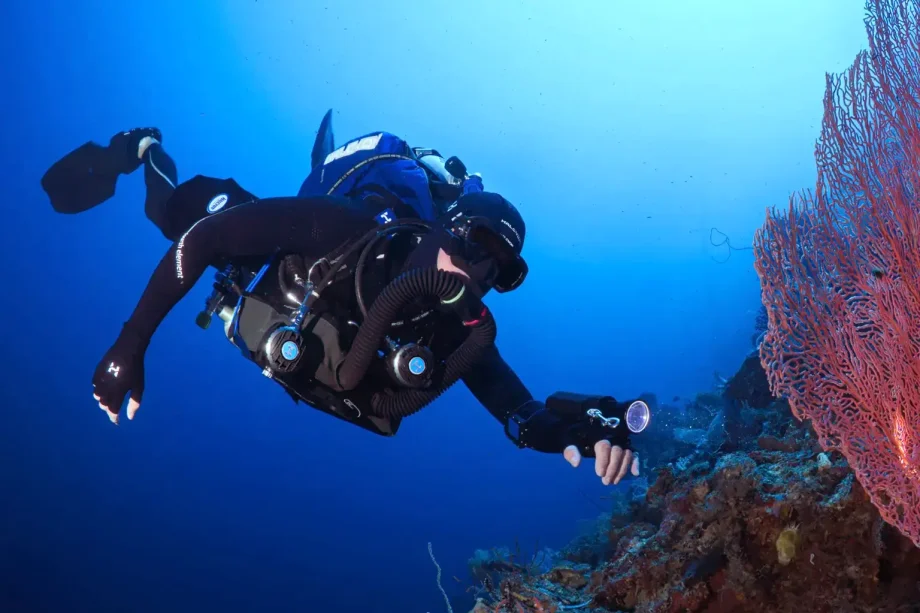
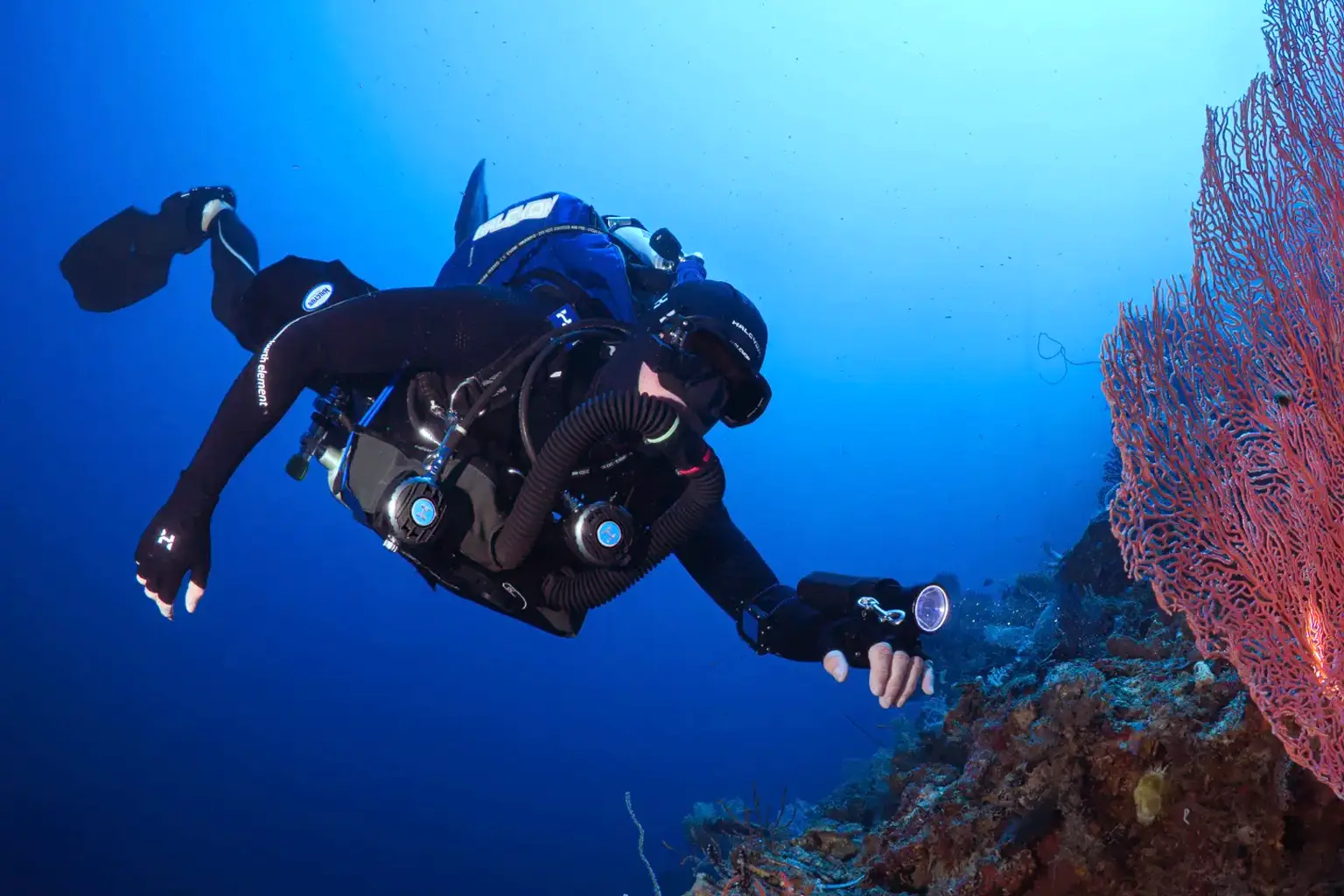

All images: Halcyon
Until now the Halcyon Symbios CCR has been distributed in a limited release model. According to Halcyon, that phase focused on scaling production carefully, building out structured training pathways, and gathering field feedback from active instructors, explorers, and early adopters putting the unit through serious use.
From mid-March, the company says production will ramp up to full capacity, expanding worldwide access to the platform.
Halcyon Symbios CCR: From Limited Release to Full Production
The staged release was deliberate. Rather than pushing broad commercial availability from day one, Halcyon placed early units with selected instructors and experienced CCR divers. The objectives were clear:
- Refine structured training and course progression
- Validate performance in real-world diving conditions
- Capture operational feedback from divers likely to identify weaknesses quickly
That validation phase is now transitioning into scaled manufacturing and broader distribution. For divers who have been watching the platform from the sidelines, availability is about to widen significantly.
Symbios: Design Priorities and Technical Architecture
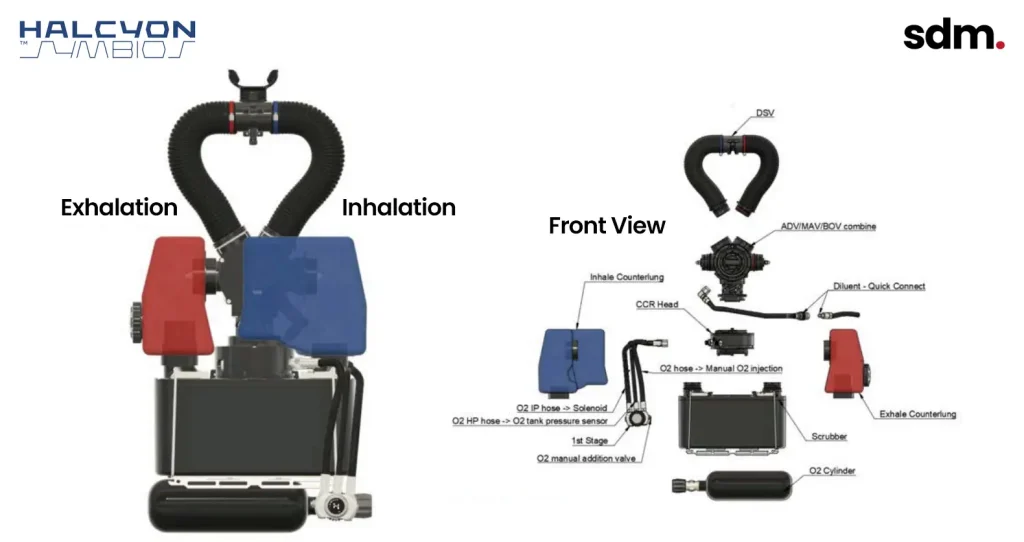
Chest-mount CCR systems live or die on ergonomics, bailout access, and electronics reliability. Symbios is built around a compact, integrated architecture that aims to address all three.
Hybrid Oxygen Sensing on the Symbios Chest-Mount CCR
Symbios uses a hybrid oxygen sensing system that combines traditional galvanic oxygen sensors with solid-state digital sensors.
The practical implication is cross-verification between sensor types. In a life-support system where oxygen monitoring is mission-critical, redundancy across technologies is a meaningful design decision rather than a marketing bullet point.
Patented Chest-Mounted ADV/BOV
One of the unit’s signature features is a patented chest-mounted ADV/BOV valve, which also functions as a manual diluent addition valve and an OC/CC selector switch.
.
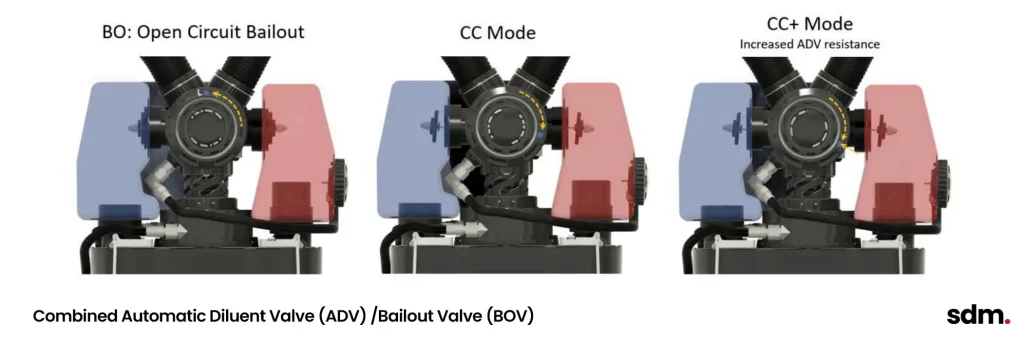
By positioning the automatic diluent valve and bailout valve at the chest, Halcyon aims to streamline open-circuit access while reducing front-end bulk at the mouthpiece. For divers logging long bottom times, minimizing jaw fatigue and hose clutter is not a trivial comfort issue, it directly affects task loading and long-dive efficiency.
Wireless Communication to Handsets and HUDs
Symbios supports wireless communication between the rebreather, its handset computers, and head-up displays (HUDs).
In practical terms, this enables:
- Clean data flow across the system
- Streamlined configuration
- Integrated logging
For teams standardizing equipment or operators managing multiple units, system-wide connectivity becomes part of long-term ownership rather than a convenience feature.
Integrated Bailout Architecture
Halcyon describes Symbios as having fully integrated bailout architecture, rather than relying on externally bolted-on solutions.
For experienced CCR divers, bailout configuration is central to planning and repeatability. An integrated approach can support cleaner routing, predictable procedures, and team standardisation, particularly in technical environments where bailout strategy is tightly structured.
Axial Scrubber and Work of Breathing
The unit uses an axial scrubber with a large cross-section and short bed length, designed to support low work of breathing (WOB).
Low WOB is not simply about comfort. In high-task or deeper dives, breathing resistance directly influences workload, CO₂ retention risk, and overall diver performance. The scrubber geometry is therefore central to the platform’s operational profile.
Halcyon Symbios CCR Weight and Travel Specifications
Halcyon positions Symbios as a portable CCR platform without stripping capability.
- Approximately 7.5 kg (15.4 lbs) in travel configuration
- Under 11 kg (24.3 lbs) fully assembled and ready to dive
For traveling CCR divers, those figures matter. Airline weight limits, packing logistics, and overall system modularity often determine whether a unit is practical for expedition travel or better suited to fixed-location diving.
The Symbios Mobile App and Digital Ecosystem
The Symbios mobile app functions as the central interface for the broader system.
Divers can use it to:
- Configure system settings
- Manage gas profiles
- Run integrated checklists
- Review detailed dive logs
While mobile integration is increasingly common in dive electronics, Symbios is positioned as a connected ecosystem spanning the rebreather, its handsets, HUDs, and mobile device. If execution is seamless, that integration can reduce friction in both pre-dive setup and post-dive analysis.
Training Agencies Supporting the Halcyon Symbios CCR
Availability without training infrastructure is meaningless in the CCR space. Halcyon’s instructor programs are already active through:
- IANTD
- Technical Diving International
- Global Underwater Explorers
Training programs with SSI and PADI are currently in development.
For prospective Symbios divers, instructor availability, agency alignment, and realistic progression planning are as important as hardware features. The mid-March expansion is likely to increase instructor capacity and geographic spread over the coming months.
Market Context: Another Serious Chest-Mount Option
The chest-mount CCR segment remains comparatively small but technically demanding. Symbios enters full production as a serious contender aimed at divers prioritizing:
- Compact front-end ergonomics
- Rapid bailout access
- Travel-friendly weight
- Connected digital ecosystems
For experienced CCR divers evaluating new platforms, or instructors considering adding a system to their teaching portfolio, the shift from limited release to full production removes one of the major barriers: access.
CCR Safety and Professional Responsibility
Closed-circuit rebreathers require formal, agency-recognized training and strict adherence to manufacturer procedures. No system design eliminates the need for disciplined pre-dive checks, conservative planning, and standardized bailout protocols.
As wider availability rolls out, the operational reality remains unchanged: platform choice is only one component of safe CCR diving. Training quality, procedural discipline, and team alignment remain decisive factors.
sdm knowledge:
Halcyon Symbios Chest-Mount CCR
The Symbios is a chest-mounted closed-circuit rebreather developed by Halcyon. It is designed as a compact, travel-conscious CCR platform with hybrid oxygen sensing, integrated bailout architecture, and wireless connectivity to handsets and HUDs.
Halcyon has stated that wider global availability begins in mid-March, with production moving from a controlled limited release to full manufacturing capacity.
• The early controlled rollout allowed Halcyon to:
• Refine structured training programs
• Validate the unit in real-world diving conditions
Collect operational feedback from instructors and experienced CCR divers
This phased approach is common with complex life-support systems where field validation is critical before scaling production.
The Symbios uses a hybrid oxygen measurement approach combining galvanic oxygen sensors with solid-state digital sensors. The goal is cross-verification between sensor types, adding redundancy in a system where accurate oxygen monitoring is mission-critical.
The Symbios features a patented chest-mounted ADV/BOV regulator. By positioning this assembly on the chest rather than at the mouthpiece, the design aims to:
• Reduce front-end bulk
• Improve ergonomics over long dives
• Provide rapid and intuitive access to open-circuit bailout
For divers concerned with jaw fatigue and hose routing, this is a notable design choice.
Rather than treating bailout as an add-on, the Symbios is built around an integrated bailout configuration. For technical divers, this supports cleaner hose routing, more repeatable procedures, and potentially easier team standardization.
The unit uses an axial scrubber with a large cross-section and short bed length. Halcyon states this design supports low work of breathing (WOB), which is critical for comfort, performance, and CO₂ management—especially during high-task or deeper dives.
According to manufacturer specifications:
• Around 7.5 kg (15.4 lbs) in travel configuration
• Under 11 kg (24.3 lbs) fully assembled and ready to dive
For traveling CCR divers, these figures influence airline logistics and packing strategy.
Yes. The Symbios mobile app allows divers to:
• Configure system settings
• Manage gas profiles
• Run integrated checklists
• Review detailed dive logs
The platform is designed as a connected ecosystem linking the rebreather, handsets, HUDs, and mobile device.
Instructor programs are active through:
• IANTD
• Technical Diving International
• Global Underwater Explorers
Programs with Scuba Schools International and PADI are currently in development.
No. The Symbios is a closed-circuit rebreather and requires formal CCR training through a recognized agency. It is intended for divers pursuing advanced or technical pathways, not recreational open-circuit beginners.