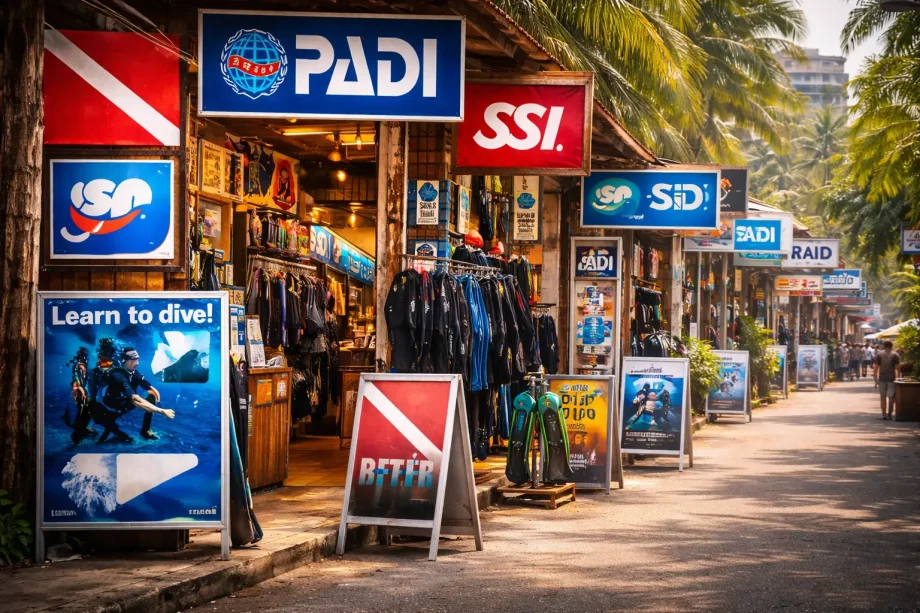
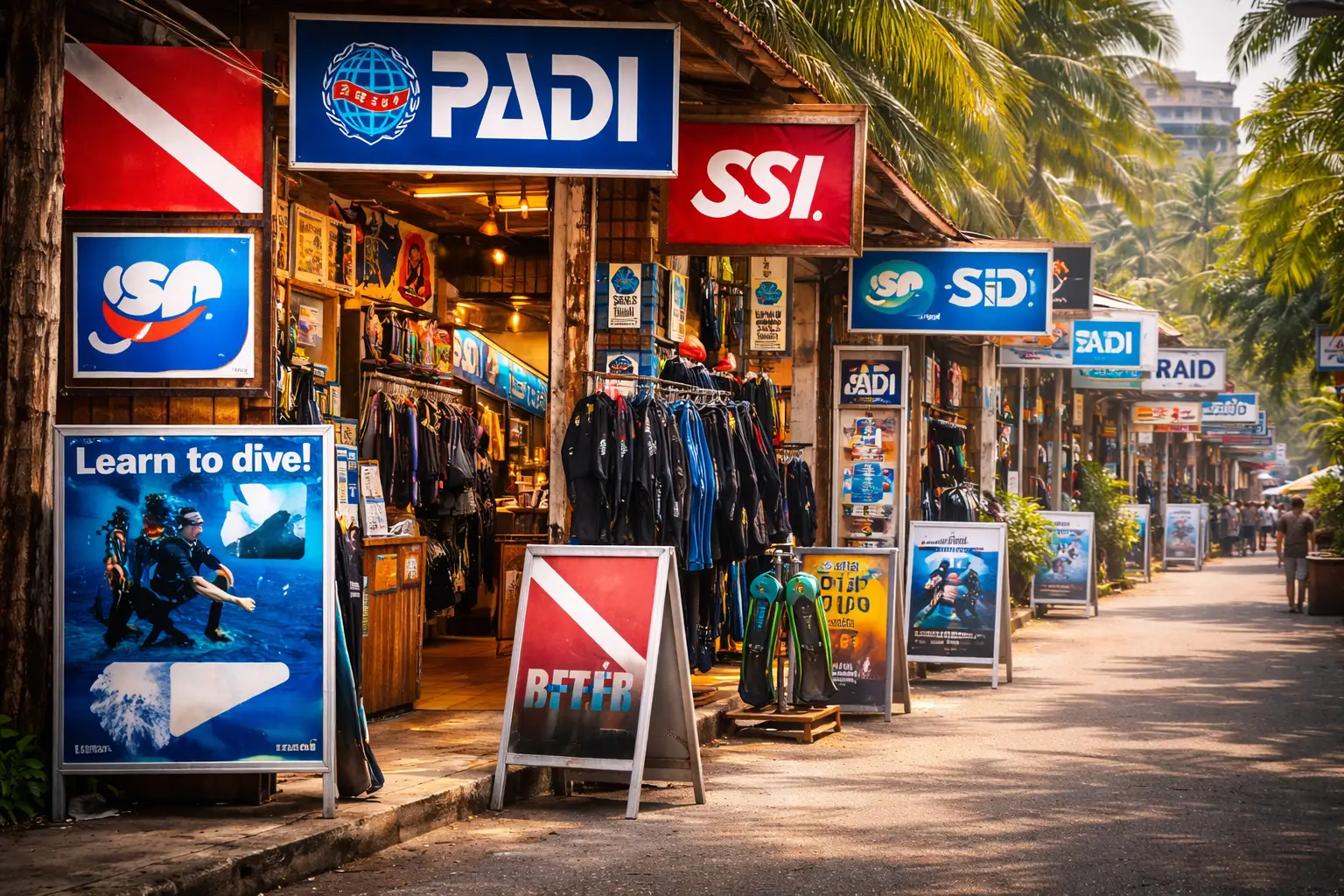

Look around: the same certification agency badges on storefronts, boat hulls, course schedules and social feeds. For new divers, the details surrounding the logos usually get quite blurry. Inevitably, the question that comes from them is simple:
“Will this card work when I travel?”
That’s the seed of what many in the industry interpret as “brand demand.” Not because new students arrive loyal to the philosophy of a specific certification agency, but because the market has been conditioned to speak in logos.
I personally know many SSI training centers and instructors who literally facepalm when a new diver arrives, saying “I want to get my PADI”.
sdm quick take:
- Most beginners want global recognition, not an ideology debate
- Logo saturation creates demand that looks organic, but often isn’t
- When every centre sells the same badge, training becomes a commodity
- Instructor quality and water time determine the outcome
- Strong centres lead with identity; the certification agency should support, not define
The demand illusion: how it gets manufactured
Let’s be honest. First-time customers rarely walk in with a deeply researched preference for one training system over another. PADI? SSI? BSAC? RAID? They don’t know the subtle differences, and probably don’t care. They DO arrive with uncertainty. And they look for visible signals of credibility.
Now, if every sign in town carries the same agency branding, that logo becomes shorthand for legitimacy. Some customers might even assume the agency owns the dive centre, franchise style. But as we know, in reality most centres and instructors are independent businesses operating under affiliation agreements.
The loop is straightforward:
- Centres heavily promote one agency
- Customers see it everywhere and start requesting it by name
- Centres cite those requests as proof of “market demand”
- The visibility increases further
In another region, a different logo or agency may dominate. The mechanism, however, remains identical. Exposure drives perceived demand.
From a marketing perspective, this is saturation at work and not necessarily informed consumer choice.
When everyone sells the same card, everyone looks the same
Here’s the uncomfortable commercial reality: when multiple operators in one destination push the same entry-level certification, they collapse into one mental category for the customer.
Same badge.
Same course title.
Same promise: “internationally recognised.”
If a lower-cost operator opens nearby offering the same branded certification, differentiation becomes invisible to beginners. To them it’s the same product, just at a lower price.
That leaves higher-quality operators in a weak narrative position:
- First: “We’re PADI too.”
- Then: “But we’re better than other PADI centres.”
Yet the outcome – the certification card – is identical at face value, governed by the same baseline standards. When differentiation disappears, competition shifts to price and convenience. And margins follow.
Standards set the floor. Instructors build the diver
Most mainstream entry-level certifications operate within comparable minimum performance expectations, particularly where programs align to widely recognised industry benchmarks.
- The certification agencies define the floor.
- Instructors and traingin centres determine what happens above that floor.
Ask experienced divers what matters and the answer is consistent: choose the instructor carefully. The problem for first-time divers…?
Well, quality only shows up in places beginners can’t easily assess on day one:
- Instructor competence and control in the water
- Sensible student-to-instructor ratios
- Repetition until skills are automatic, not just demonstrated
- Buoyancy and trim integrated early, not postponed
- A visible, consistent internal safety culture
Two students can complete the same ‘branded’ course and leave with very different comfort levels, awareness, and control.
Same logo. Same certification. Very different diver.
The hidden vulnerability for centres
There’s also a structural risk for dive businesses that lean heavily on agency identity.
Centres and instructors carry much of the local marketing weight:
- signage
- course promotions
- social media
- event presence
- volume targets
But they do not control:
- fee structures
- policy changes
- standards revisions
- global brand messaging
- cross-border strategy decisions
If the centre’s identity is mostly an extension of the agency’s brand, it becomes exposed to decisions made elsewhere.
Over time, brand-led marketing compresses differentiation. The centre becomes a distribution point rather than a distinct training provider.
Operators that scale sustainably tend to reverse that hierarchy:
- The centre’s safety culture, instructor development, and training philosophy lead
- The agency framework supports
Not the other way around.
What this means for divers
For divers choosing where to train, the logo should be the starting point and not the deciding factor.
A widely recognised certification is useful, for sure. But long-term capability depends on how the course is delivered.
Questions students should be asking before booking:
- Who will actually teach me, and can I speak with them first?
- What are the in-water ratios?
- How much time is dedicated to buoyancy, trim, and ascent control?
- What happens if I need additional sessions to reach consistency?
- Where will training take place (conditions, depth progression, sheltered options)?
Strong centres will answer clearly, without defensiveness and without regurgitating whatever is stated in the certification manual. If the response defaults to brand recognition alone, you’re being sold a logo.
A note on safety
Training quality has real-world implications. Rushing a course to match a travel schedule or promotional window can create long-term skill gaps.
If core skills, such as buoyancy control, mask work, air-sharing, controlled ascents etc, don’t feel stable and repeatable, it’s a responsibility to request more water time with students before progressing. Regardless of timeline pressure.
Confidence built early reduces risk later.
The bigger industry conversation
For industry leaders, the key takeaway here isn’t about being anti-agency. Agencies provide structure, quality control, and global interoperability. All extremely valuable.
The risk emerges when the branding of an agency replaces differentiation.
If every shop in a region markets the same badge louder than its own competence, the sector drifts toward commoditisation. Price pressure follows. Instructor retention becomes harder. Training time compresses.
Centres that want to future-proof themselves need to:
- Invest in instructor development beyond minimum standards
- Build their own visible internal training philosophy
- Market outcomes (control, confidence, progression pathways)
- Treat agency affiliation as infrastructure, not identity
Because in the long term, newly qualified divers won’t stay in the sport because of a logo. They stay because they feel capable underwater. And that outcome is built by people like us, not by the branding of a certain certification agency.