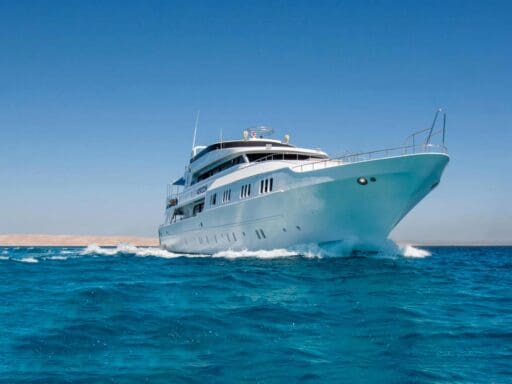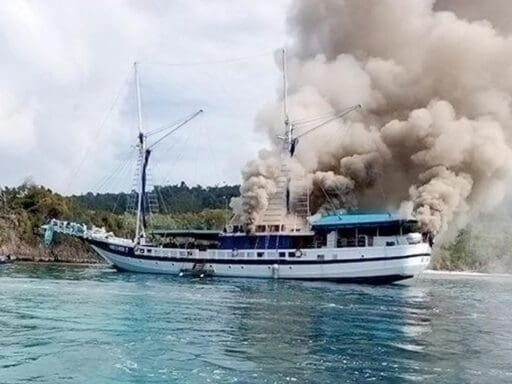


A Chinese tech billionaire is attempting something the global boating industry has struggled with for decades: making yacht ownership affordable for ordinary consumers.
Richard Liu, founder of the Chinese e-commerce giant JD.com, has launched a new marine venture called Sea Expandary with reported backing of roughly $700 million. The project aims to build mass-market recreational yachts designed to dramatically lower the cost of boat ownership.
The ambition is simple but disruptive. If yacht manufacturing can be scaled using automation, modular construction, and artificial intelligence–assisted design, smaller recreational yachts could eventually cost little more than a car.
If that vision becomes reality, the ripple effects could extend far beyond recreational boating. The scuba diving industry, dive tourism market, and global liveaboard diving sector could all feel the impact.
A Push Toward Mass-Market Yacht Ownership
The global yacht market has traditionally been built around luxury. Motor yachts and cruising yachts typically cost hundreds of thousands or even millions of dollars, limiting ownership to a small group of wealthy buyers.
Sea Expandary is trying to challenge that model by applying mass-production strategies that have transformed other industries such as automobiles and consumer electronics. The company is exploring manufacturing systems that rely on modular construction, automated production lines, and AI-driven hull design in order to dramatically reduce production costs.
If those efficiencies can be achieved, entry-level yachts could theoretically drop to around 100,000 yuan, or roughly $14,000. At that price level, recreational boating would no longer be a luxury hobby. It would become a consumer product.
That shift could open the door to millions of new boat owners, particularly in Asia where rising middle-class wealth is fueling demand for leisure activities linked to coastal tourism and marine recreation.
China itself is becoming a key test market for this idea. Cities such as Shenzhen, Zhuhai, and coastal regions of Hainan have been investing heavily in marina construction, marine tourism infrastructure, and yacht industry development. The growth of domestic tourism and leisure boating is already accelerating, and a wave of affordable yachts could expand the sector dramatically.
What Mass-Market Yachts Could Mean for Scuba Diving
For the global scuba diving community, cheaper yachts could fundamentally reshape how divers access the ocean.
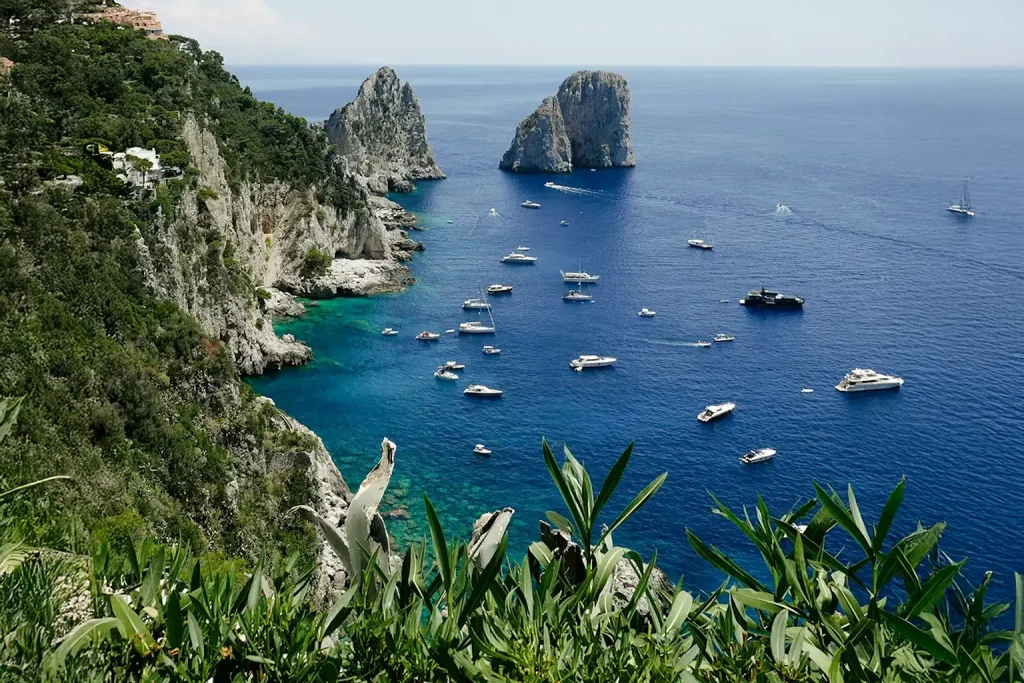
Many divers currently rely on organized dive operators or day boats to reach offshore reefs, wrecks, and remote dive locations. Owning or chartering a vessel is often prohibitively expensive for individuals or small dive clubs. If affordable recreational yachts become widely available, that barrier could fall.
Lower-cost vessels could enable more independent dive trips, small private charters, and club-organized expeditions. Divers could reach offshore reefs without relying entirely on commercial dive operations, and coastal regions with strong diving communities might see a rise in small local dive charters operating from privately owned boats.
For adventurous divers, mass-market yachts could unlock entirely new forms of exploration diving. Groups of experienced divers might organize private multi-day trips to remote islands, offshore pinnacles, or little-visited wreck sites. In regions where shore diving is limited, affordable boats could dramatically expand access to dive locations that currently require organized tours.
At the same time, the expansion of recreational boating could increase pressure on fragile marine ecosystems. Coral reefs around the world already face stress from tourism, climate change, and coastal development. More boats on the water could increase anchor damage, fuel pollution, and diver traffic at sensitive dive sites.
Popular dive destinations such as the Red Sea, Thailand, Indonesia, and the Caribbean are already managing the environmental impact of heavy dive tourism. A major increase in recreational boating would likely intensify the need for mooring buoy systems, marine protected areas, and stricter regulation of dive site access.
How Cheap Yachts Could Disrupt the Liveaboard Diving Industry
Perhaps the most interesting long-term question is how mass-market yacht manufacturing could affect the liveaboard diving industry, one of the most distinctive segments of dive tourism.
Traditional liveaboard dive boats are large, purpose-built vessels designed to carry between 12 and 30 divers on week-long itineraries. These vessels are expensive to build and operate, which is reflected in trip prices that often range from several thousand dollars per guest.
If smaller yachts become dramatically cheaper to produce, the economics of liveaboard diving could change.
One possible outcome is the emergence of micro-liveaboards. Instead of large dive vessels carrying dozens of divers, operators might launch compact expedition boats designed for small groups of six to ten guests. These smaller vessels could offer flexible itineraries, reach more remote locations, and operate with lower overhead costs.
Such a shift could create a new tier of dive tourism focused on small-group exploration diving, bridging the gap between day boats and large liveaboards.
At the same time, cheaper boats could lower the barrier to entry for new dive operators. Entrepreneurs and dive professionals might be able to launch small liveaboard-style operations with significantly less capital investment than today. Increased competition could push innovation in the liveaboard sector and potentially lead to more varied trip formats, including shorter itineraries and niche expeditions.
There is also the possibility that experienced divers could organize private expeditions using chartered or owned vessels. In some regions, dive clubs already rent boats for multi-day trips, but widespread availability of affordable yachts could make this approach far more common.
However, running a safe and reliable dive vessel involves far more than simply owning a boat. Crew training, safety systems, dive operations, insurance, and maritime regulation remain major operational factors. Even if vessels become cheaper, professional liveaboard operators will still play a critical role in maintaining safety and logistical expertise.
The Environmental Question Behind Affordable Yachts
Sea Expandary has indicated that its yacht designs could incorporate solar panels, wind assistance, and energy-efficient propulsion systems. These technologies could reduce fuel consumption and help limit emissions.
Even so, the environmental equation remains complex.
A major expansion in global recreational boating would increase marine traffic, marina development, and coastal infrastructure. Without careful management, these changes could add new pressure to coral reef ecosystems and sensitive marine habitats.
For the scuba diving community, this raises an important question. Divers are among the most active advocates for ocean conservation, but increased access to the ocean also brings greater responsibility.
If cheap yachts succeed in opening the sea to a much larger population of boat owners, the future of diving destinations may depend on stronger marine protection policies and responsible tourism practices.
The Future of Ocean Access
The idea of mass-market yachts might sound radical today, but history shows that once luxury technologies become scalable, they often move quickly into mainstream consumer markets.
If Sea Expandary or similar companies succeed in dramatically lowering yacht prices, the boating industry could undergo a transformation similar to what happened when automobiles moved from luxury goods to everyday transportation.
For scuba divers, that future could bring greater freedom to explore the ocean — and new opportunities for innovative dive tourism and liveaboard operations.
It could also mean a much busier ocean.
How the diving industry, marine regulators, and conservation groups respond may determine whether cheaper yachts become a positive evolution for ocean access or another pressure point for already vulnerable marine ecosystems.
sdm. knowledge
The mass-market yacht project is being led by Chinese entrepreneur Richard Liu, founder of JD.com. His marine venture, Sea Expandary, aims to scale yacht manufacturing and dramatically reduce the cost of recreational boat ownership.
Some early projections suggest entry-level models could fall to around 100,000 yuan, roughly $14,000. Achieving that price would require large-scale production efficiencies, automated manufacturing, and modular boat construction.
Lower-cost yachts could make it easier for divers, dive clubs, and small operators to reach offshore reefs, wrecks, and remote islands without relying entirely on traditional dive boats or commercial operators.
If smaller vessels become significantly cheaper to build, dive operators could experiment with compact expedition vessels or “micro-liveaboards.” These smaller boats could carry fewer divers but offer more flexible itineraries and potentially lower operating costs.
A large increase in recreational boating could increase anchor damage, fuel pollution, and overcrowding at sensitive dive sites. Marine protection measures such as mooring systems, protected areas, and stricter dive site management would become even more important.